

When students share how they use artificial intelligence, Janelle Grey sees it as a teachable moment.
"When I work with students who have used AI, I usually follow up with, ‘Beyond the answer, what did you learn?’” she said. "If they have trouble answering that question, I know there's an opportunity to help them learn to better use this new tool."
That instinct to meet students where they are and redirect them toward something better is what took Grey and colleague Beth Lisi from SUNY Jamestown Community College's Learning Center to Seattle this spring, where they presented at the Association for the Coaching & Tutoring Profession national conference.
Their session, titled "Thinking Outside the Bot: Artificial Intelligence for Real Learning," drew fellow practitioners from community colleges, large universities and graduate programs across the country seeking to steer their students toward the best AI learning paths.
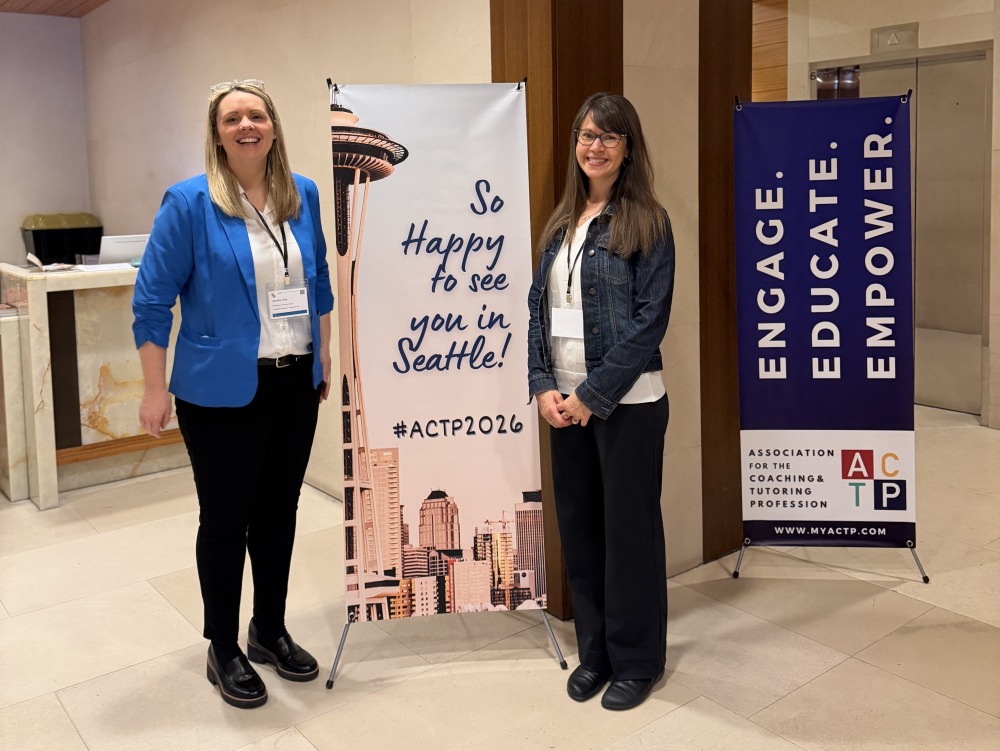
Grey is an assistant professor and coordinator of the Learning Center on the Jamestown Campus, while Lisi is an associate professor and coordinator of the Learning Center on the Cattaraugus County Campus. Their presentation developed and grew from their own experiences tutoring and supporting JCC students.
"It came to be because it was a need that we saw in working with students," Lisi said. " We know they're going to use AI, but we want to help them learn to use it to support learning rather than undermine it."
A central theme of the presentation was teaching students to use AI as a learning partner rather than an answer machine. The key, Grey and Lisi explained, is how students interact with AI as a guide to ask questions rather than simply deliver solutions.
"We talk about how to more effectively prompt large language models, so that AI is helping students through the problem-solving process as needed, as opposed to giving them the answer," Lisi said. "So they can prompt AI to act more like a tutor that's asking them questions when they get tripped up, as opposed to just outright telling them the answer."
That approach connects to a broader concept Grey refers to as "productive struggle."
"In education sometimes the best learning happens when you are in the process of the struggle,” Grey said. “It’s important to teach students to be OK with that, but to use tools to help them get unstuck."
Lisi illustrated the idea with a practical example.
"Instead of just asking AI to solve this math problem, you try to solve it yourself," she said. "You get to a point where you're stuck and then you ask it to help you solve that part. So you have to know that you're stuck, number one. Number two, how you're stuck. And number three, what questions to ask to get unstuck. It's forcing them to really think through that instead of just passively getting the answer."
The presentation also spotlighted a tool that is free to students: the NotebookLM application from Google. Students can upload their class materials to the platform, which generates a range of study sources from them.
"It can be as simple as things like flashcards that we're all familiar with, an outline, or more complex," Lisi said. "It can create a talking head video of the topic. It can create a podcast. It can create diagrams, mind maps, and infographics."
Those different formats matter because of how people learn.
"Multimodal learning is when students are getting the same information but in different ways," Lisi said. "They're seeing it, they're hearing it, they're seeing it broken down into details and pieces. They're seeing it more holistically. And that supports learning, and just as importantly, retention of information."
Grey and Lisi, both of whom have been at JCC for than a dozen years, are no strangers to presenting at national conferences. They presented remotely at the Teaching Academic Survival and Success conference in 2020 about first-year student experience courses.
Part of their goal for the Seattle conference was simply to keep the AI conversation moving in the right direction, rather than present themselves as AI experts with all the answers.
"We don't have all the answers, but since students are using it we do need to be thinking about it and talking about it," Lisi said. "Part of the reason we wanted to talk about this topic — in addition to maybe giving practitioners who are similar to us some new tools — it's also just to get people thinking and get the conversation either started or continued."
The response suggests Grey and Lisi tapped into something their counterparts across the country are hungry for.
"Colleagues stopped us after our session and asked for our presentation materials, and even struck up conversations in the elevator." Grey said. "They wanted to continue the conversation with us and share their own experiences."