
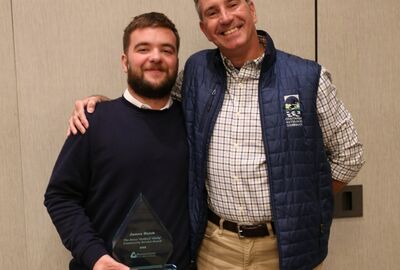
On a quiet trail, away from the hustle and bustle of traffic, computer screens and cellphones, James Haick feels most at home.
Whether working on a farm or supporting individuals with disabilities at The Resource Center in Jamestown, Haick's life has consistently circled back to one place: the outdoors.
"It's just important to be outside," he says.
Now a dozen years removed from high school and preparing to graduate from SUNY Jamestown Community College this spring, Haick is clear about what he wants to do next. He hopes to build a career in trail development — not behind a desk, but hands-on, shaping outdoor paths that are both environmentally sustainable and accessible to people of all abilities.
"I don't really want to be a park ranger," he said. "I want to be more hands-on on the trails."
That clarity didn't come overnight.
After high school, Haick worked on a farm before spending nearly a decade in health care. At The Resource Center, where he works as a direct support professional, he assists individuals with daily living skills, promotes their independence and helps integrate them into the community.
Part of that integration often means getting outside to parks, festivals and local trails. But those outings sometimes revealed troubling realities.
"We'd take them to festivals or parks, and the driveways just weren't wheelchair-friendly," he said. "You need a hard surface. There's just a lot of different challenges that we face."
Despite the physical barriers, he saw how meaningful outdoor access could be.
"It's their independence," he said. "They live with other people all the time. Sometimes you just want to get away."
That realization reshaped his academic path at JCC. As an Individual Studies major, Haick intentionally selected courses to prepare him for trail work, including biology classes to understand ecosystems, writing courses to strengthen communication, and media writing and communications classes to help him advocate effectively.
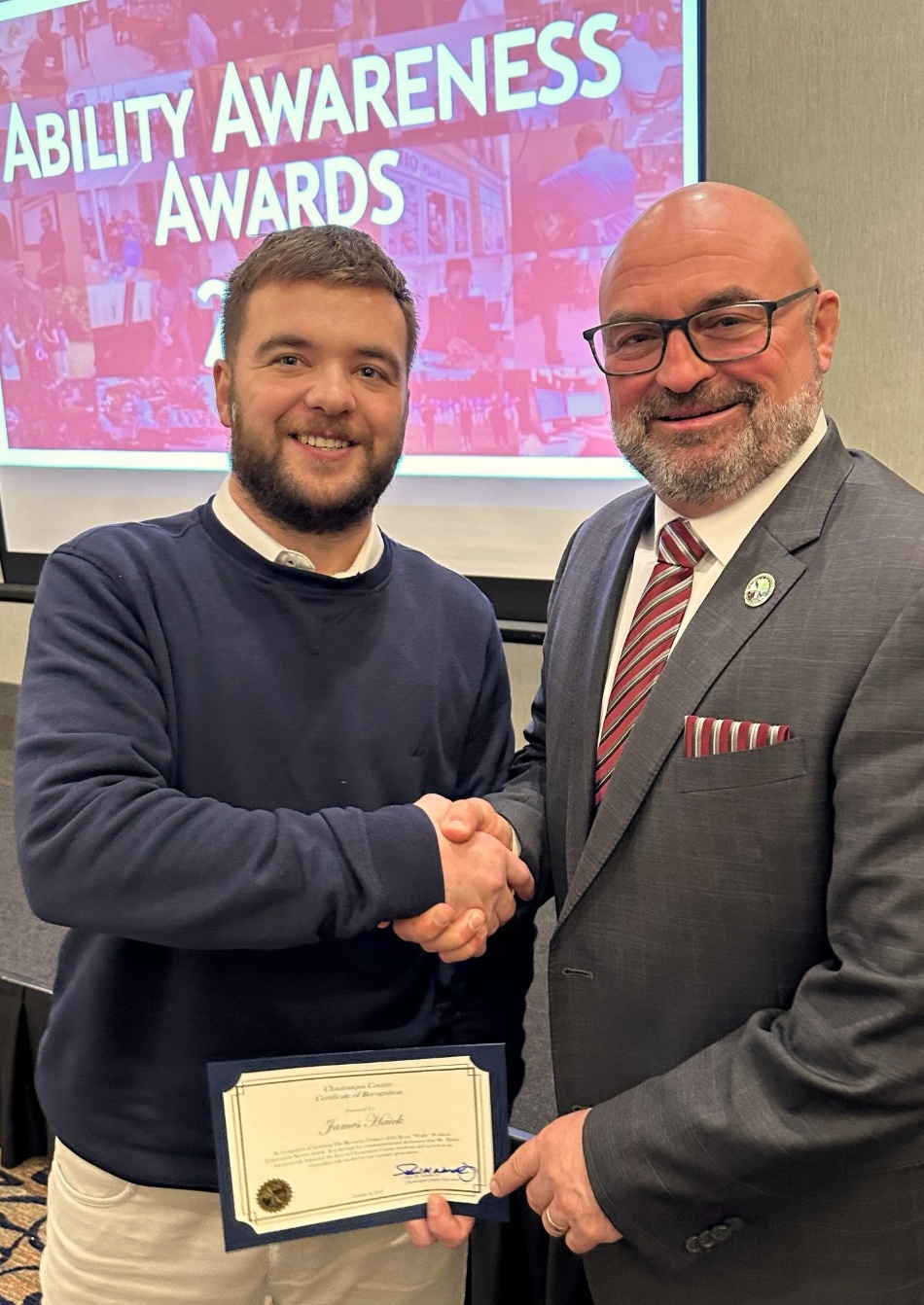
Executive PJ Wendel for his work with the Chautauqua Watershed Conservancy.
Experience, he knew, would matter just as much as coursework.
In January 2025, he began his first internship with the Chautauqua Watershed Conservancy, supervised by faculty advisor Shannon Bessette. What started as a conversation about accessibility grew into three internships and a yearlong effort to help create lasting change.
"He initially approached me to act as his faculty supervisor with some ideas about making local hiking trails more accessible and inclusive for everyone," Bessette said. "I admire several things about James, including the fact that his goals seemed absolutely overwhelming when he started his first internship. He did a tremendous amount of research about accessibility and inclusion, and talked through possibilities with me and his supervisors at the Chautauqua Watershed Conservancy."
Haick helped establish the Nature for All Committee, a group dedicated to improving trail accessibility across the region. The committee includes advocates, individuals with disabilities and representatives from local organizations, all working toward more inclusive outdoor spaces.
"It's not my project," Haick said. "It's a community project."
Drawing on the Forest Service Trails Accessibility Guidelines, the Americans with Disabilities Act and the Architectural Barriers Act, he helped develop an accessibility audit checklist that will be used to assess Chautauqua County preserves such as Dobbins Woods, Loomis Goose Creek and Cassadaga Lakes. The goal is to provide clear information about trail surfaces, grades and potential barriers so visitors can make informed decisions before they arrive.
At the same time, Haick rolled up his sleeves at the Jamestown Riverwalk Community Labyrinth on Jones and Gifford Ave. The space had become badly overgrown and damaged, and Bessette said simply clearing it out was no small task.
"Just removing weeds, mowing and weedwhacking was a demanding physical task," she added.
But Haick went further. He removed deteriorating raised garden beds, installed cement planters donated by the city of Jamestown, planted trees and worked to restore the space. The project earned him the Bruce Walford Community Support Award last fall during The Resource Center's annual Ability Awareness Awards celebration.
Haick plans to continue improving the Labyrinth, adding native plants and creating a more welcoming space for both the individuals he supports and the broader community.
As his internships near their end, Haick is building a spreadsheet of resources and recruiting volunteers to carry on the work.
"He signed up for two more internships so he could see these projects through, which is pretty rare," Bessette said. "He's been dedicated and determined, even when things seemed really difficult."
Haick has applied for trail crew and development positions in New York, Pennsylvania, Maine and Michigan, including roles with state parks and nonprofit trail organizations. To strengthen his qualifications, he is pursuing additional training in sustainability, accessibility and trail design, knowing that skills such as masonry, construction and equipment operation are often required in the field.
"I say 31 is getting old," he said with a laugh. "But at the same time, I still got time to learn."
That mindset has defined his return to college. Haick credits several JCC faculty members for encouraging his path, especially Bessette.
"She's definitely been the biggest supporter," he said.
He also points to Kirk Parmenter, an associate professor of biology, and Karen Weyant, an associate professor of English, as mentors who challenged and supported him along the way.
As a member of JCC's Sustainability Committee, Haick encourages fellow students to explore the on-campus College Park trails and think about how outdoor spaces can serve everyone.
For him, trail development is not just about building paths through the woods. It is about removing barriers — physical, social and informational — so that more people can experience the benefits of being outside.
Haick sees his graduation not as an endpoint, but as a beginning. There are more skills to learn, more certifications to earn and more trails to build.
Most importantly, there are more people to include.
"I want to shine a light," he said, "on the importance of being outside."