
JAMESTOWN, N.Y. — Vincent Gerace spent nearly four decades in law enforcement. As an adjunct instructor at SUNY Jamestown Community College, he's passing that knowledge to the next generation.
Gerace teaches Criminal Investigation at JCC, a course he describes as "a helicopter view of what criminal investigation entails, from the collection of evidence, to questioning subjects, to all the way to culmination, to trials, and court appearances."
His credentials run deep. Gerace began his career in 1980 as a patrol officer and transferred to the Chautauqua County Sheriff's Office in 1985. Four years later, he moved into forensic identification, a role now commonly known as CSI.
"I was trained by world-renowned experts in the area of forensics," Gerace said.
He went on to help establish the county's forensic investigation team, which officially launched in 2000 and remains active today.
Gerace retired about a decade ago as a lieutenant after 36 years in law enforcement. But he wasn't ready to step away entirely.
"I was asked to teach forensics here at the college and give my real-world experience to the students," he said. "And I still have something to offer, I feel."
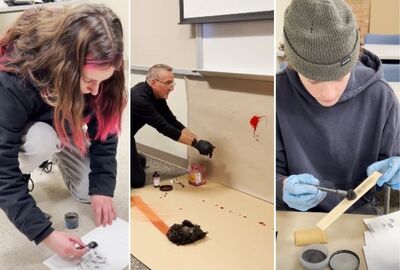
JCC's Criminal Justice courses emphasize practical, hands-on training. Gerace's classes are no exception.
Students begin with fingerprint analysis, learning to identify loops,whorls,and arches before fingerprinting each other and categorizing their own prints. From there, they move into latent fingerprinting, which involves uncovering hidden prints and comparing them to known samples.
"Latent is a word that means hidden," Gerace explained. "We teach the students how to make those fingerprints unhidden and develop them."
The course also covers trace evidence, including the proper collection of DNA, and the chain of custody required for courtroom presentation.
"You need to have a nice tight chain of custody," Gerace said. "Each student actually secures blood stains and properly tags and bags and documents those stains."
Blood spatter analysis follows, with students learning to interpret patterns and track the source of blood using angles and math. They study passive stains shaped by gravity, transfer stains left when someone wipes a bloody surface, and the science behind reconstructing a scene.
"The stains can tell you a lot," Gerace said.
Students also learn to collect and cast footwear impressions using dental stone, a skill Gerace relied on throughout his investigative career.
"When I was an investigator and I would go into different scenes, I always wanted to at least come out with having footwear secured at a scene," he said.
For students considering a career in criminal justice, Gerace has a simple message: believe in yourself.
"My message to anyone that's thinking of getting in this field is that you can do it," he said. "If you told me when I was a young person thinking of getting into police work that I was going to be in charge of the most important crime scenes in the county, I would say no way."
Confidence, he said, comes with knowledge.
"You're not born with that knowledge. You gain that knowledge. You gain that confidence," Gerace said. "As you gain knowledge, you gain the confidence, and you can do it."
JCC offers multiple pathways for students interested in criminal justice, including associate degree programs and connections to regional law enforcement training. Gerace himself has been teaching at the college's Chautauqua County Sheriff's Academy since the late 1980s.
For more information about Criminal Justice programs at JCC, visit sunyjcc.edu/programs.