
This story is the final of a series marking the 50th anniversary of SUNY Jamestown Community College's Cattaraugus County Campus in Olean and its impact on the region. Visit sunyjcc.edu/News to read additional articles.
---
The story of the SUNY Jamestown College’s Cattaraugus County Campus is, in many ways, a story of resilience and reinvention.
From starting at a former Olean elementary school building with five classrooms and six full-time faculty in 1976 to growing to a 12-acre downtown campus with seven buildings, JCC has continually adapted to deliver expanded access to higher education to thousands of Cattaraugus County residents while helping meet workforce needs across the Southern Tier.
As JCC celebrates its 50th anniversary in Olean, college leaders are looking beyond the milestone and toward the role the campus could play in shaping the region's future.
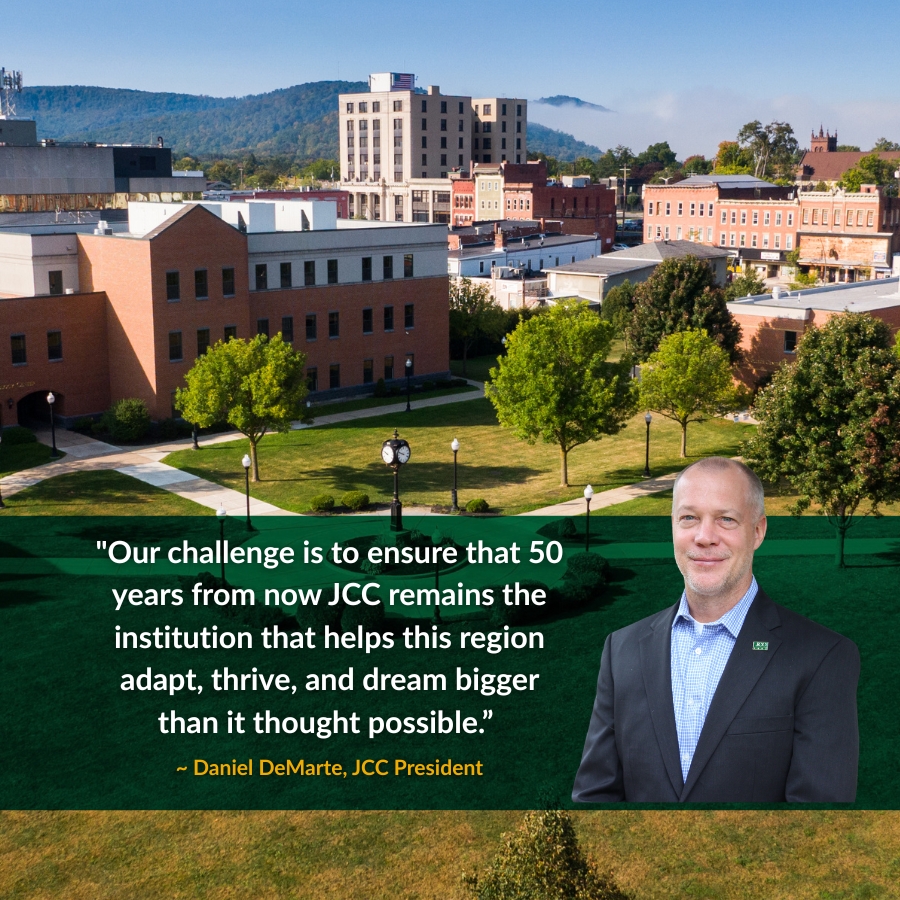
Cattaraugus County Campus.
JCC President Daniel DeMarte said the next 50 years will require the Cattaraugus County Campus to evolve the same way it has over the last 50 years.
"If the first 50 years were about expanding access,” DeMarte said, “the next 50 may be about expanding opportunity, innovation, and regional impact.”
The traditional path of attending college immediately after high school is changing, he said, and community colleges like JCC are increasingly serving learners at every stage of life.
"The traditional model of attending college between ages 18 and 22 is evolving," DeMarte said. "Education is becoming less of a one-time experience and more of a lifelong relationship."
Those benefitting from JCC’s offerings may be high school students earning college credit, adults preparing for new careers, workers updating their skills as technology changes, and retirees pursuing personal enrichment.
Preparing students and workers for the region's evolving economy will remain a priority.
"The future economy will require talent in healthcare, advanced manufacturing, information technology, energy, data analytics, and emerging industries," DeMarte said. "The campus can serve as the region's primary workforce development engine, connecting education directly to employment and helping employers stay competitive."
While advances such as artificial intelligence, virtual reality, and simulation technology are expected to reshape education, DeMarte said the college's greatest strength will continue to be its personal approach.
"The campus of 2076 may look technologically unrecognizable from today's campus, but its mission of helping people realize their potential will remain unchanged," he said.
DeMarte shared that community colleges are becoming hubs where education, business, government, health care providers, and nonprofit organizations work together to solve regional challenges.
As rural communities face workforce shortages and changing demographics, DeMarte believes JCC can play an even greater role in helping residents build careers close to home while supporting entrepreneurship and economic growth.
"For 50 years, the Cattaraugus County Campus has changed lives by opening doors to education, opportunity and personal growth," DeMarte said. "The true legacy of this campus is not measured in buildings or programs, but in the thousands of students who found a pathway to a better future and the communities they have strengthened in return."
Looking ahead, he said, the college's responsibility is to build on that foundation.
"Our challenge,” DeMarte said, “is not simply to preserve that legacy, but to reimagine it and to ensure that 50 years from now JCC remains the institution that helps this region adapt, thrive, and dream bigger than it thought possible.”