
This story is part of a series marking the 50th anniversary of SUNY Jamestown Community College's Cattaraugus County Campus in Olean and its impact on the region. Visit sunyjcc.edu/News to read additional articles.
---
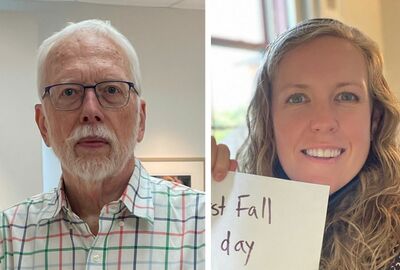
Dale Yerpe was there in 1976 when SUNY Jamestown Community College first opened its doors in Olean. Fifty years later, he's still on campus, still teaching English.
The close-knit atmosphere Yerpe experienced as one of five full-time faculty members teaching in six classrooms inside the former Homer Street school building five decades ago remains much the same today at JCC’s Cattaraugus County Campus in downtown Olean.
It's one of the main reasons he's stayed so long while many of his contemporaries have been retired for a decade or more.
"When we hire faculty here, they get the sense that they're like one-person departments," Yerpe said. "It really depends on them. The college, campus, and the students. I mean, if you don't show up, there's nothing to replace you. You're needed here. You're important here."
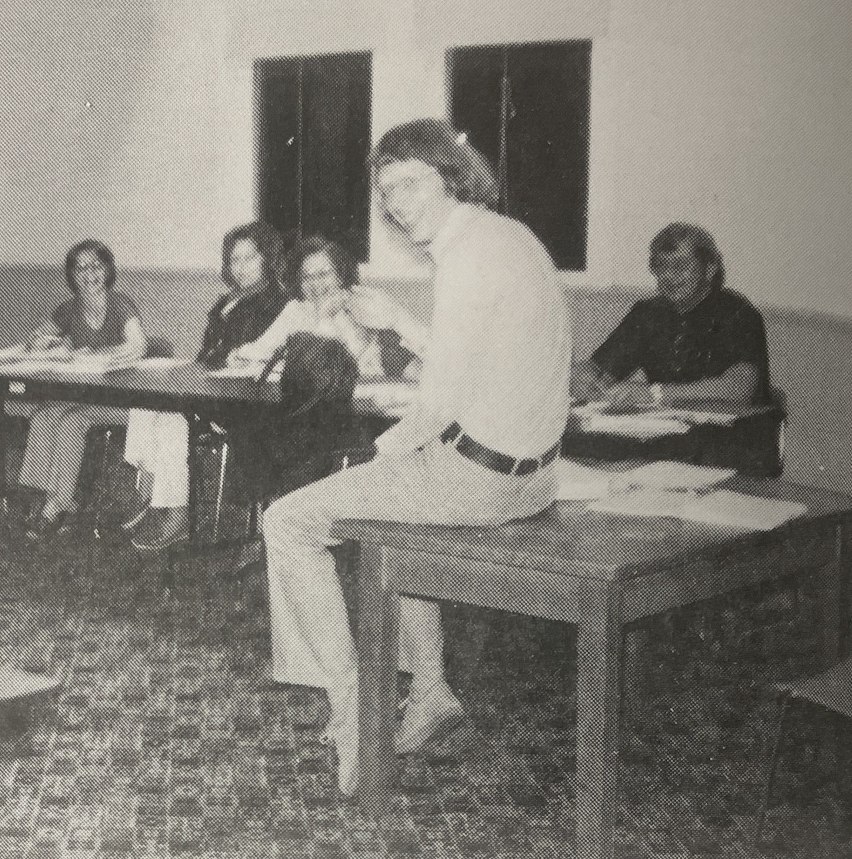
Campus in 1976.
Few people have witnessed JCC's evolution in Olean as closely as Yerpe. He has seen the college grow from the former Homer Street school building to the former Montgomery Ward department store on North Union Street and, eventually, to its current 12-acre, 7-building campus in downtown Olean.
The college began in 1976 after Alfred State College closed its four-year-old Olean extension because of budget constraints, leaving JCC to build a campus from the ground up.
When Yerpe first walked into the nearly 100-year-old former Olean School No.8, it was in desperate need of repairs that weren’t coming anytime soon.
"They added paint and color to the building," he said. "It was very drab. There was a blue room, there was an orange room ... the blackboards were actual slate. They must have weighed a ton."
Flipping through the college's 1976-77 yearbook brought back a flood of memories for Yerpe.
There was the building entrance, with administrative offices to the left and "Mary Grace's Place" on the right. That's what everyone called the small cafeteria area managed by Grace, a retired woman who had worked in the restaurant business and served hot dogs, hamburgers and French fries to hungry students, faculty, and staff.
"It was Mary Grace's Place because we didn't have a name for it," Yerpe said. "It was really pretty neat."
Near the back of the book, was a photo of Ted Baker, a do-it-all who doubled as a history instructor and the building's maintenance chief.
There was one of the library, which occupied the building's old gymnasium and where tall bookshelves perilously wobbled whenever someone walked by.
"A lof of the books we had were stamped with Alfred State College," Yerpe said with a grin.
And several showing Ted Smith, the first dean in Olean, who "wanted us to try things," Yerpe said. "He was always open to new things and getting students engaged."
Other than James McCabe, who taught philosophy, and Leon Sterle, who taught math, the rest of the faculty was young and new to teaching.
"It was a sort of an experiment, and if we screw up, we're all first-year people," Yerpe said with a shrug. "We all forgive each other."
Yerpe witnessed JCC grow rapidly from just over 300 students in 1976 to more than 900 in 1983 and topping a thousand shortly thereafter, prompting the need for a real campus downtown in the 1990s.
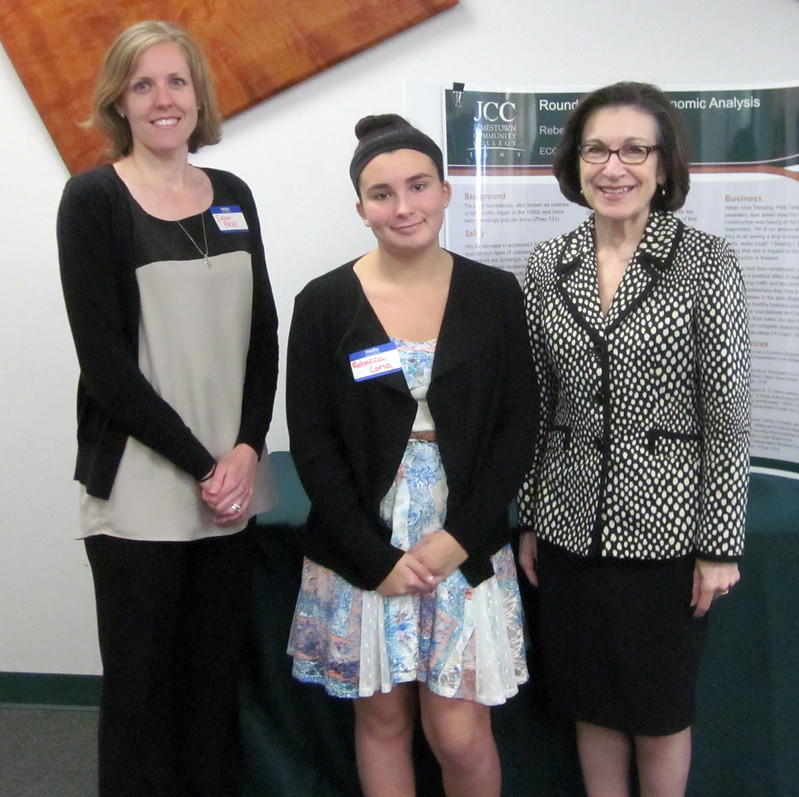
Zagora during Scholars Day on the Cattaraugus County Campus in 2016.
Sarah Bray, an associate professor of Business and chair of the Business department, has taught at JCC since 2013 and has witnessed similar rapid change over 13 years on the job. The students are different, and the classrooms are not the same, with much more instruction delivered online.
“It’s a fun challenge for me to make sure I’m getting to know them and what they want so I can help provide the experience they came for,” she said. “It’s not the same thing day in and day out. It’s always different. Our students bring that energy. They’re constantly changing, and they’re all different individuals needing different things. I like that.”
Bray originally came to JCC as an adjunct instructor while serving as a technology consultant for small businesses. One of the big things she tries to instill in students is being able to nimbly adapt to change in the business environment.
She embodies that in her own work, moving deftly from teaching in person to instructing groups of students on video. No matter the delivery, Bray said fellow JCC faculty are just as dedicated to educating students.
“Our colleagues are top notch,” she said. “We have the privilege of working with people who really care about their jobs, and they care about their students.”
Yerpe is near the front of that line.
In the mid 1970’s, fresh out of college himself, it was exciting to help build a community college from almost nothing. Faculty, staff, and students all worked together.
"That was one thing about being here when everything was just new," he said. "We're going to have a student rally. Who's going to help us? You'd all pitch in. Famously, we had one rally where the students got a little carried away."
Yes, the one where a gasoline-soaked dummy was positioned on the roof of the Homer Street building. It exploded into pieces across the sky upon being ignited.
"We always wondered what people saw from the expressway,” Yerpe recalled with a laugh.
That dummy may be long gone, but 50 years later, Yerpe and JCC are still going strong.
"I can't think of anything more fun to be doing," he said. "I absolutely love the people I work with."