
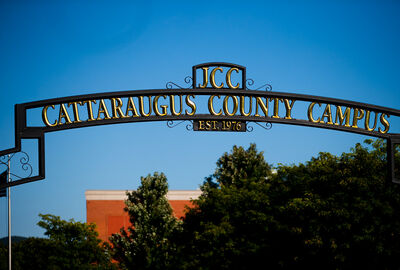
This story is the first in a series marking the 50th anniversary of SUNY Jamestown Community College's Cattaraugus County Campus in Olean and its impact on the region. Visit sunyjcc.edu/News to read additional upcoming articles.
---
When SUNY Jamestown Community College opened for classes Aug. 30, 1976, at 722 Homer St. in Olean, faculty and staff were literally building the new Cattaraugus County venture on the fly.
The fall class schedule wasn't completed until three days before the first day of classes. Students couldn't receive financial aid that semester, forcing the college to scramble for emergency loan funds while faculty and staff personally loaned money to students in need.
The nearly 100-year-old former Olean School No. 8 building, which housed classes and administrative offices, presented its own challenges.
During the first winter, according to campus Dean Ted Smith, workers found 27 holes in the roof. Only half of the restrooms were operational. By the winter of 1977, the heating system failed, leaving students and faculty to wear coats in class.
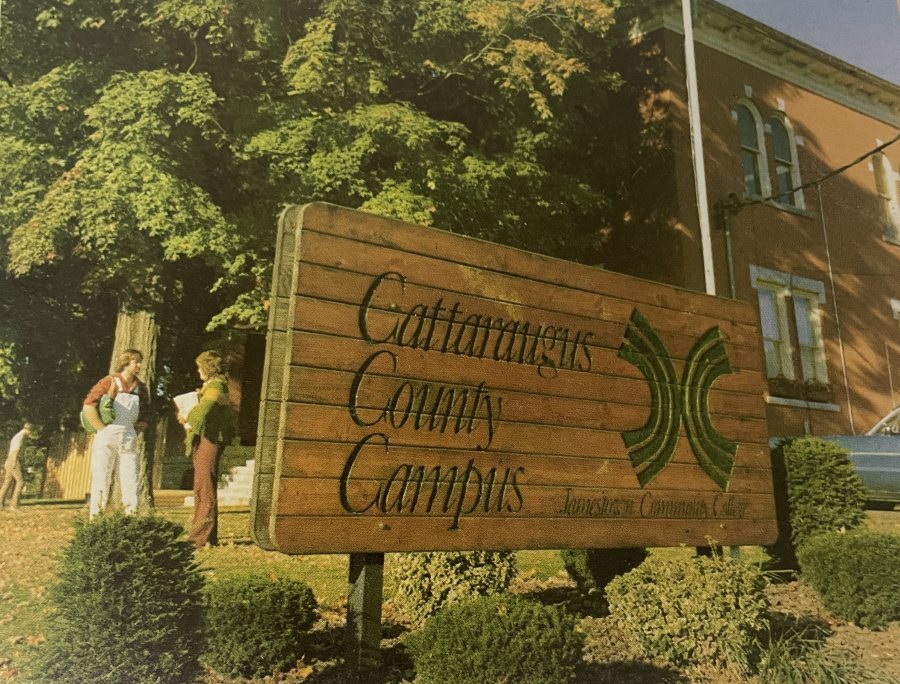
Smith reflected on those early years in a 1979 newsletter published by JCC, describing the college's growing pains as "comical, frustrating, enjoyable, and sometimes frightening."
"Of course, not all of the limitations were bad," Smith wrote. "They built character among our students, faculty, and staff."
That resilience carried JCC through years of rapid growth and stability.
JCC’s Cattaraugus County operation began after Alfred State College closed its four-year-old Olean extension because of budget constraints. While Alfred State primarily offered evening classes for working adults, JCC, expanded opportunities for recent high school graduates planning to transfer to four-year colleges.
Starting with five full-time faculty and additional adjuncts, JCC enrolled 307 students in its first fall semester and 345 the following spring. Alfred State's Olean extension never had more than 208 students.
By the early 1980s, JCC had added counseling and tutoring services, along with programs in computer science and electrical technology. Enrollment topped 900 students by 1983, and the college employed 17 full-time faculty members and more than 35 adjunct instructors.
As enrollment climbed, mobile classrooms were added outside the Homer Street building. JCC also rented classrooms at the former Transfiguration Parochial School on Elm Street, labs at BOCES, and gym space at Boardmanville Elementary School for intramural activities.
“We actually had a little minivan that would take you back and forth from Homer” to Elm Street, said Tammy Skroback, a 1980s graduate and longtime Cattaraugus County Campus employee. “Oh, it was fun,” she added. “That was the fun era.”
JCC moved downtown to the spacious Montgomery Ward departmetn store building in time for fall classes in 1984.
“It was an interesting building because it still had the feel of a department store,” said Dale Yerpe, an English professor since the campus’ first days. “You would go in the front doors, and it’d go a whole two floors up. The ceiling was two floors high. And they had these old fans to circulate the air up there. They looked like airplanes propellers.”
There was a mezzanine for offices that looked down at the expansive first level, which Yerpe said, “was a really nice gathering area.”
Skroback’s first job at JCC was working the switchboard in Montgomery Ward.
“I was at the top of the stairs, as people called it, ‘the lingerie,’” Skroback said. “That's where the lingerie (department once) was. And then they moved things all around, and then the switchboard ended up down on the main floor.”
The Montgomery Ward building soon became part of a growing downtown footprint.
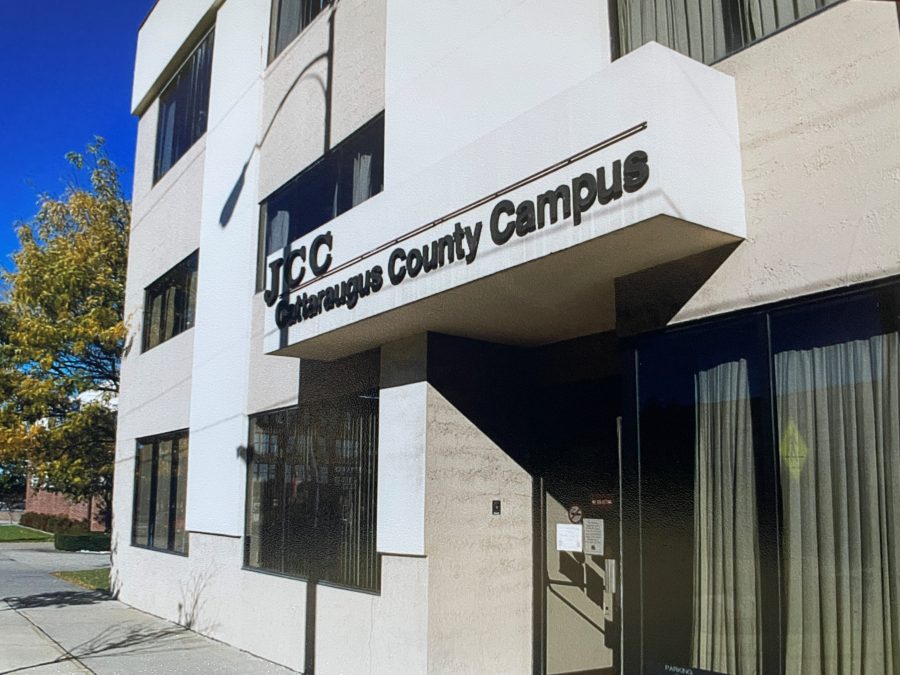
In the late 1980s, JCC revamped the nearby train depot and large cold storage building into a fine arts center and academic hall with an expanded library, respectively.
By 1992, the college enrolled nearly 1,300 full- and part-time students, who often hung out between classes in parking lots owned by the city that are now part of the campus’ back lawn.
“It was packed with students,” said Paula Snyder, the longtime campus Health Center director who later served as the campus’ executive director. “We used to get phone calls from surrounding businesses saying you’ve got to get your students out of our lots.”
By the late 1990s, Yerpe said “JCC had decided we need an actual campus. We need a campus feel. It needs to be more than a couple of buildings."
Snyder, also a member of the city council in the 1990s, recalled that part of the city’s revitalization plan counted on JCC remaining downtown.
“It was very clear to the Olean people and the Olean governance that JCC was going to be an anchor to save this downtown,” Snyder said. “This was always part of the city’s plan to keep JCC here.”
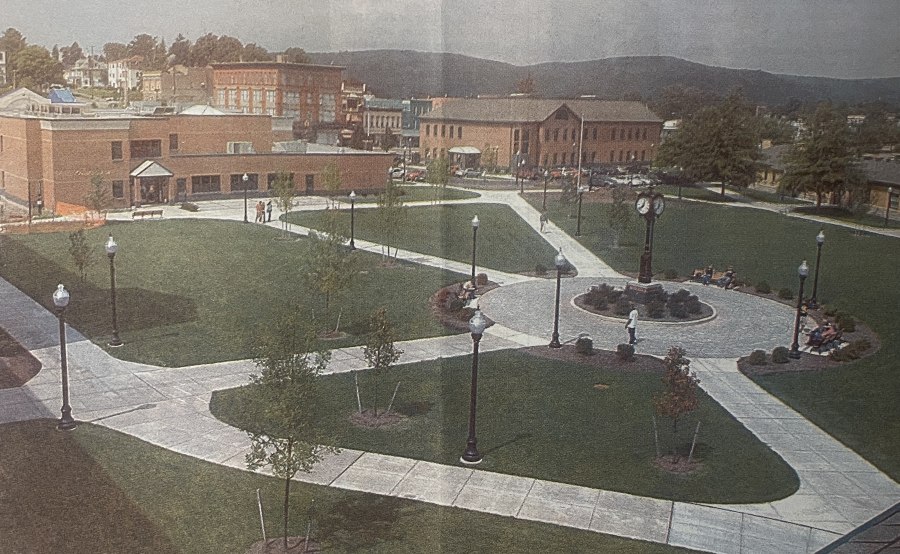
The result was the construction of a 12-acre, six-building campus that opened in 2003.
The sprawling landscaped quad of the present-day campus, Yerpe said, was a dangerous construction zone for more than a year as new buildings were erected, and parking lots cleared for greenery.
“After they were all done, they planted these trees,” Yerpe said, pointing to the quad. “As these trees get older, you start to recognize that’s how long it has been.”
For Yerpe, the growth of JCC was part of a much larger movement that had drawn him to community colleges in the first place.
While he was earning a bachelor’s degree in English from SUNY Fredonia, he recounted a "movement to bring education to everyday people" through community colleges that offered low tuition close to home.
The Clarence native struggled to find a high school teaching job, but "there was a special (master's degree) program that was federally funded to prepare community college teachers," he said.
The growth eventually slowed as the region's demographics and economy changed. Due to cuts to some academic programming, regional population loss, and demographic changes beginning around 2010, the campus no longer enrolls 1,000 students or more.
However, the college remains a critical training ground for future nurses, manufacturing professionals, and incumbent employees in the region.
A seventh building was added to the campus in 2016 with the opening of the Manufacturing Technology Institute, which is home to machining, welding, engineering, and workforce development opportunities.
In recent years, the Hatch Cafe, run by JCC’s Workforce Development staff, and the JCC YMCA Early Childhood Learning Center have opened on campus. The remodeled Cutco Theater has become a home for family movie showings and other events, while the campus continues to host a variety of community gatherings on its lawns and in its buildings.
“I like that we host community events on this campus,” said Kaitlyn Caya, a campus Student Services assistant. “I like that people know that we’re here to rent rooms from. We’re very integral to our community because you can stay right in this community and get your schooling done and become a nurse or go into the workforce. We’ve opened up all these opportunities for people in our community. It’s not just fresh-out-of-high-school kids coming here. We have adult learners. We have people who want to pivot and start a new career. They’re able to do that.”
Five decades after those first students walked into the former Olean School No. 8, Sarah Bray, an associate professor of Business on the Cattaraugus County Campus since 2013, sees the same fundamental value in JCC.
JCC, Bray said, remains “such a good choice for a college-bound student. It makes so much sense financially, sociologically, and for growing up for a traditional college student coming from high school. It’s such a good choice for so many students from that perspective.”