
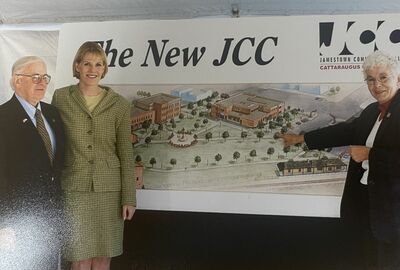
This story is part of a series marking the 50th anniversary of SUNY Jamestown Community College's Cattaraugus County Campus in Olean and its impact on the region. Visit sunyjcc.edu/News to read additional articles.
---
Looking back on the effort to build SUNY Jamestown Community College's new campus in downtown Olean, former President Greg DeCinque still remembers what longtime Cattaraugus County Legislature Chairman Jim Snyder said when it was finally finished.
The stars had aligned.
“He was dead right,” said DeCinque, who served as president from 1994 to 2013. “It took hundreds of people. Boy, you had to get the stars to align to make this happen.”
And if they hadn't?
“We would have continued to probably limp along,” DeCinque said. “We could not have done the campus without the support.”
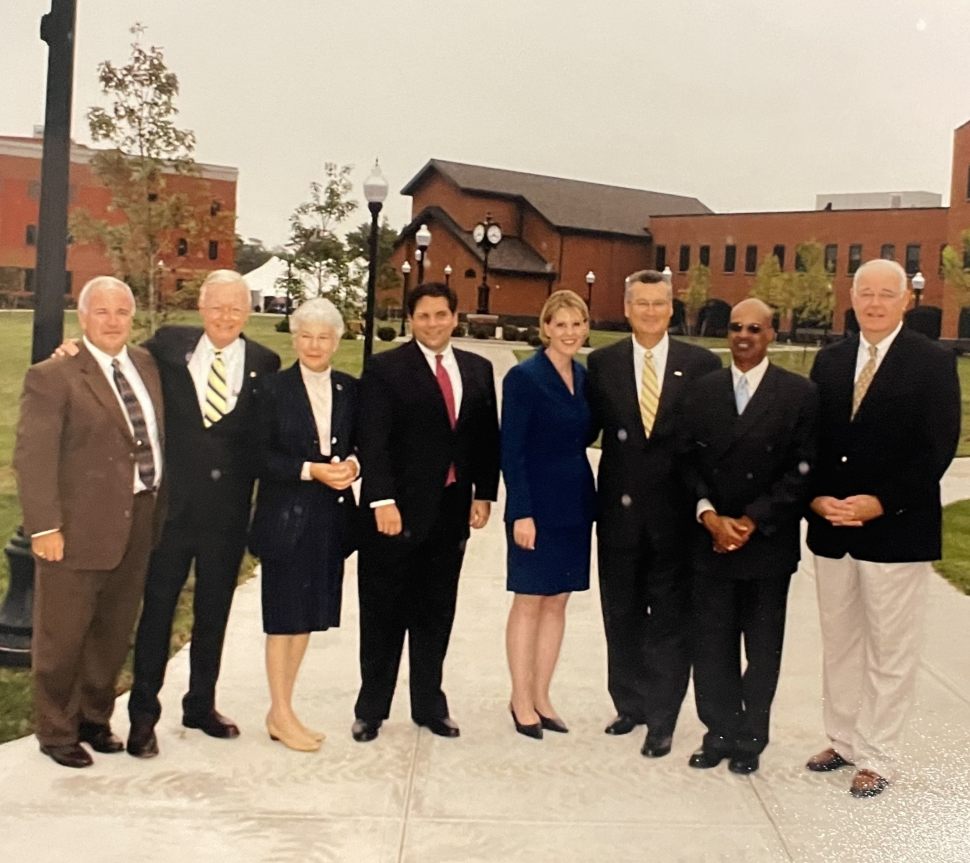
community leaders on the new downtown Cattaraugus County Campus in 2003.
As JCC celebrates its 50th anniversary in Olean, the modern campus on North Union Street stands as the result of years of political debate, funding challenges, and property negotiations that nearly kept the project from becoming reality.
Before the expansion, JCC's future in Olean and Cattaraugus County was anything but certain.
As it moved from its original Olean location on Homer Street in 1976 to the old Montgomery Ward department store downtown – and places between – JCC never owned any of its buildings. Without Cattaraugus County as a sponsor, DeCinque said, the college could only lease space.
Before new construction, the Olean campus consisted of the Montgomery Ward building, the renovated cold storage building at the corner of North Barry and East Sullivan streets, and the revamped train depot on East Sullivan Street.
“The campus that was there before regionalization was all rented facilities,” DeCinque said. “They were not top notch. It was a really a desire once we regionalized to bring that campus into a much better state to deliver services to folks in Cattaraugus County.”
Yet, when JCC was regionalized with sponsorship from Cattaraugus and Chautauqua counties in the mid-1990s, it didn’t automatically pave the way to a permanent campus in Olean.
For that, JCC needed an $8 million commitment from Cattaraugus County to pair with $15 million from New York state and $7 million from the college for the $31 million project. Convincing county lawmakers to support the project proved to be one of the toughest hurdles.
Before a March 1999 vote on the expansion plan, more than 200 people attended a public meeting hosted by the legislature in Olean. Among those speaking in support of the project were Vince Volpe, Dresser-Rand chief operating officer; Erick Laine, president and CEO of Alcas Corp.; and Robert Catalano, president and CEO of Olean General Hospital.
Outside the city building that night, dozens of JCC students, alumni, faculty and staff gathered with signs supporting the new campus.
Nonetheless, a poll conducted by the Olean Times Herald and published days later showed there was not enough support among the county's 21 legislators.
In that newspaper article, Snyder, the legislator, said: “I am very optimistic the legislature is going to do the right thing. It may not be in the present package, but the legislature is not going to let the community college leave the county.”
The expansion plan initially passed after lawmakers approved a hotel and motel occupancy tax to reduce the burden on county taxpayers. However, the vote was later repealed following opposition from hotel and lodge owners in Ellicottville.
“It was a tough sell to get people to understand that this was a critical investment in the future of the county,” DeCinque recalled. “The legislators lined up on different sides of the issue. Some didn’t think that they should put the money in.”
The breakthrough came in 2000, when Cattaraugus County received a $42 million national tobacco settlement to be paid over 25 years. The settlement provided the funding needed for the county's commitment to JCC.
“It was a long process,” DeCinque said. “Once the funding was in place, then it was a matter of working with the city to find a location. It wasn’t just assumed that the downtown location would be the final location. It was a process we all went through looking at four or five different possibilities for locating the campus, but ultimately it was decided that downtown was the best location. There was a lot of support for that choice.”
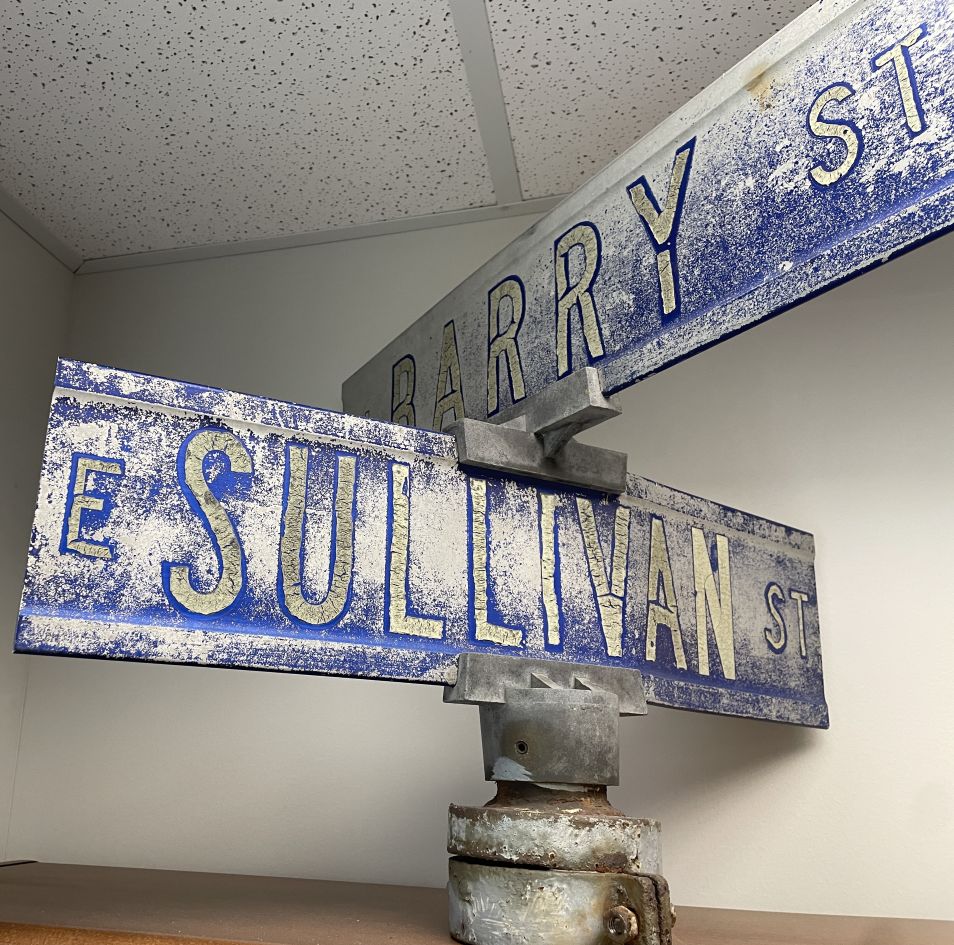
campus in downtown Olean. The former street signpost is housed in the president's
office on campus.
When the new 12-acre, six-building campus opened for the fall semester in 2003, it included the new Allied Health and Sciences Center, Technology Center, and Cutco Theater, to go with the remodeled College Center. It also featured a wrought iron gateway entrance on North Union, and a four-face clock tower overlooking a sprawling landscaped quad that replaced former parking lots.
After the campus opened, Laine, who led a capital campaign that raised $1.5 for the project, said the new JCC “has exceeded my expectations. It brings tears to my eyes even to think about it because it’s so grand. The campus has a sense of gravity and dignity to it. The architecture is just fantastic.”
In addition to Laine, DeCinque credited Magnano, Gary Winger, JCC’s vice president of administration, JCC faculty and staff, and Snyder, Joe Eade, and Jess Fitzpatrick of the Cattaraugus County Legislature with helping bring the project to completion.
“It allowed us to maintain a presence in Cattaraugus County that might not have lasted if we hadn’t been able to do this,” said DeCinque, who still lives in Ellicottville.
Before retiring in 2013, the JCC president emeritus also oversaw the college’s purchase of the former Knights of Columbus building on Hamilton Street, allowing the Olean campus to expand again. The Manufacturing Technology Institute was constructed on the site and opened in 2016.
“That was something we always wanted to get done,” DeCinque said, “so we could broaden the offerings in Cattaraugus in skilled trades and the other kinds of programs that were pretty key to economic development in the county and area.”
More than two decades after it opened, the Olean campus stands as the permanent JCC home that DeCinque and many others spent years working to secure, serving students in Cattaraugus County in a way that once seemed far from guaranteed.
Said DeCinque: “I think people, in hindsight, probably do think that this was a good thing to help the city of Olean as well as provide educational and other services to the community.”